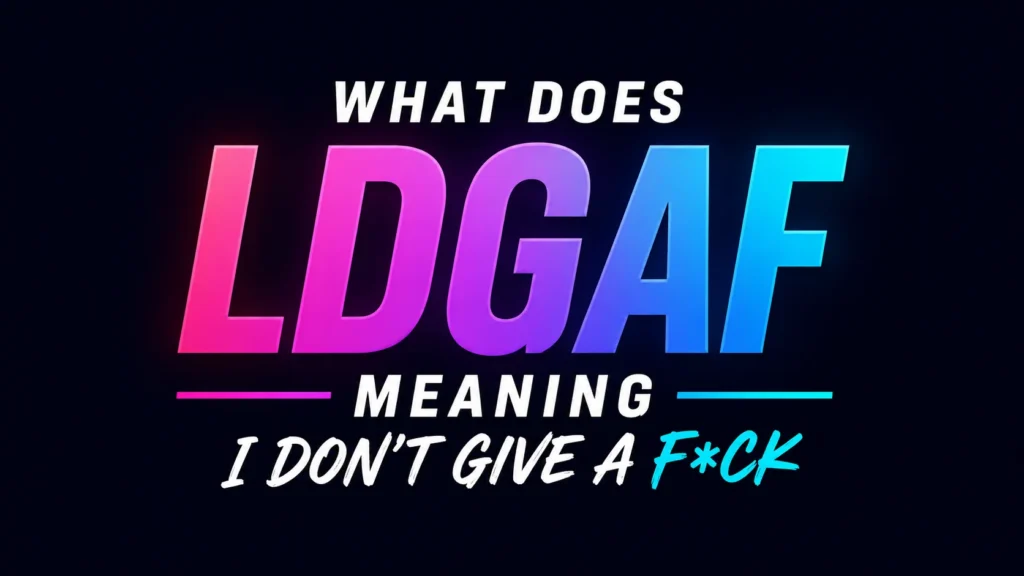
If you’ve recently seen “LDGAF” in a text message, TikTok comment, Instagram caption, or online conversation, you may have paused and wondered what it actually means.
Internet slang evolves quickly, and abbreviations often appear without explanation. While some acronyms become mainstream, others remain part of specific online communities before spreading across social media platforms. LDGAF is one of those expressions that can confuse people at first glance.
Understanding the LDGAF meaning helps you interpret online conversations more accurately and avoid misunderstandings. Whether you’re trying to decode a message from a friend or understand a viral post, this guide explains exactly what LDGAF means, where it came from, how people use it, and when it may or may not be appropriate.
LDGAF Meaning – Quick Definition
LDGAF stands for:
“Literally Don’t Give A F*.”**
It is an intensified version of the phrase “I don’t care.”
People use it to express:
- Complete indifference
- Emotional detachment
- Confidence in their decisions
- Refusal to be affected by criticism
- A rebellious or carefree attitude
Examples
“People keep talking about me, but I LDGAF.”
“Wear whatever you want. LDGAF what others think.”
“At this point, I honestly LDGAF anymore.”
The expression is usually informal and often carries a strong emotional tone.
Origin & Background
Like many internet abbreviations, LDGAF emerged from online communication where people wanted to express emotions quickly and efficiently.
The phrase “I don’t give a f***” has existed for decades in everyday English. However, as texting, online gaming, social media, and messaging apps became more popular, users started shortening common phrases into acronyms.
Eventually:
- IDGAF = I Don’t Give A F***
- DGAF = Don’t Give A F***
- LDGAF = Literally Don’t Give A F***
The addition of “literally” emphasizes the feeling even more. It suggests that the speaker genuinely has no concern about the issue being discussed.
Social Media Influence
Platforms such as:
- TikTok
- Snapchat
- X (formerly Twitter)
- Discord
helped spread expressions like LDGAF.
Many users adopted the phrase as part of confidence culture, self-expression, and online humor. It often appears in captions, memes, reaction videos, and comments where people want to project independence or emotional resilience.
Over time, the phrase evolved from simple indifference into a statement of personal freedom and self-confidence.
Real-Life Conversations
WhatsApp Conversation
1st Person: Did you see what they posted about you?
2nd Person: Yeah.
1st Person: Aren’t you upset?
2nd Person: Honestly, LDGAF.
Instagram DM
1st Person: People are criticizing your new haircut.
2nd Person: They always criticize something.
1st Person:True.
2nd Person: LDGAF. I love it.
TikTok Comments
Commenter 1: Everyone hates this trend.
Commenter 2: LDGAF. It’s fun.
Text Message
1st Person : Your ex is dating someone new.
2nd Person: Good for them.
1st Person You’re taking it well.
2nd Person: Yeah, I LDGAF anymore.
Emotional & Psychological Meaning
Although LDGAF literally means “I don’t care,” the emotional message behind it can vary.
Sometimes people use it because they genuinely feel detached.
Other times, it serves as emotional protection.
The expression may communicate:
- Confidence
- Independence
- Frustration
- Defiance
- Emotional exhaustion
- Personal growth
Interestingly, communication experts often notice that people use strong language when they want to establish emotional boundaries.
For example, imagine someone who spent months worrying about others’ opinions. After finally gaining confidence, they might post:
“Living my life now. LDGAF what anyone thinks.”
In that situation, the phrase isn’t necessarily rude. It’s a declaration of self-acceptance.
At the same time, context matters. Some people use LDGAF as a mask for hurt feelings, while others genuinely mean they are unaffected.
Usage in Different Contexts
Social Media
LDGAF frequently appears in:
- Captions
- Memes
- TikTok videos
- Comment sections
- Reels
Example:
“Starting over at 30 and LDGAF what people say.”
Here, the phrase signals confidence and personal empowerment.
Friends & Relationships
Among friends, LDGAF often communicates honesty and emotional transparency.
Example:
“Everyone skipped the party.”
“LDGAF. We had fun anyway.”
In relationships, however, the phrase can sometimes sound dismissive depending on tone.
Work & Professional Settings
Using LDGAF in professional communication is generally not recommended.
Emails, meetings, and workplace conversations require more respectful language.
Instead of saying:
“LDGAF about that policy.”
A better alternative would be:
“I don’t think that issue affects my priorities.”
Casual vs. Serious Tone
Casually, LDGAF may sound humorous or confident.
In serious conversations, it can sound aggressive or insensitive.
Understanding the audience is essential before using it.
When NOT to Use It
There are situations where LDGAF may create unnecessary problems.
Avoid using it:
During Professional Communication
The language can appear disrespectful.
During Emotional Discussions
Someone sharing personal feelings may interpret it as cold or uncaring.
Around Authority Figures
Teachers, managers, clients, and senior colleagues may view it negatively.
In Formal Writing
Business documents, academic work, and official communications should avoid slang.
During Conflict Resolution
If someone is trying to solve a problem, responding with LDGAF may escalate tension.
Common Misunderstandings
People Assume It Always Means Rudeness
Not necessarily.
Many users simply mean they are choosing not to stress about something.
It Doesn’t Always Mean Lack of Emotion
Someone can care deeply about certain things while using LDGAF toward criticism or negativity.
Confidence vs. Arrogance
Observers sometimes confuse confidence with arrogance.
The speaker may be expressing self-assurance rather than disrespect.
Literal vs. Figurative Meaning
People often exaggerate online.
A person saying LDGAF may still care somewhat but wants to appear strong or unaffected.
Comparison Table
| Expression | Meaning | Tone |
|---|---|---|
| LDGAF | Literally don’t care at all | Strong, confident |
| IDGAF | I don’t care | Direct |
| DGAF | Don’t care | Casual |
| Whatever | Indifference | Mild |
| No worries | Relaxed acceptance | Friendly |
| It matters to me | Opposite meaning | Caring |
| I appreciate that | Opposite meaning | Respectful |
| Couldn’t care less | Strong indifference | Informal |
Key Insight
The main difference is intensity. LDGAF communicates a stronger emotional distance than most similar expressions. It is often used when someone wants to emphasize complete disregard for criticism, pressure, or outside opinions.
Variations and Related Types
1. IDGAF
I don’t give a f***.
The most common version.
2. DGAF
Don’t give a f***.
A shorter variation.
3. IDC
I don’t care.
Less intense and more polite.
4. NMP
Not my problem.
Suggests responsibility lies elsewhere.
5. Whatever
Casual indifference.
6. Couldn’t Care Less
Strong dismissal of a topic.
7. Unbothered
Popular social media term meaning unaffected.
8. Zero Fs Given
Humorous way to express complete indifference.
9. Not Concerned
A softer and more mature version.
10. Minding My Own Business
Focuses on personal boundaries rather than dismissal.
How to Respond When Someone Uses It
Casual Replies
- “Fair enough.”
- “I get that.”
- “You do you.”
Funny Replies
- “Tell us how you really feel.”
- “Zero percent concerned, huh?”
- “That’s one way to handle it.”
Mature Replies
- “As long as you’re happy.”
- “I respect your perspective.”
- “That makes sense.”
Respectful Replies
- “I understand where you’re coming from.”
- “Everyone has different priorities.”
- “Thanks for being honest.”
Regional & Cultural Usage
Western Culture
In North America and much of Europe, LDGAF is commonly associated with independence, authenticity, and self-confidence.
Many people use it humorously or as a statement of personal freedom.
Asian Culture
Some Asian cultures place stronger emphasis on social harmony and respect.
As a result, openly expressing LDGAF may sometimes be viewed as overly blunt.
Middle Eastern Culture
Context matters significantly.
Among close friends, the expression may be understood casually, but in formal situations it can appear disrespectful.
Global Internet Usage
Online communities often interpret LDGAF as confidence rather than hostility.
Memes and social media trends have helped standardize its meaning worldwide.
Generational Differences
Gen Z
Often uses LDGAF as a form of empowerment, self-expression, or humor.
Millennials
Generally understand the phrase but may use it less frequently.
Older generations may view it as unnecessarily aggressive due to the profanity it contains.
Is It Safe for Kids?
LDGAF contains an implied profanity, even when abbreviated.
Many teenagers encounter the expression online and understand its meaning.
Parents and educators should recognize that the phrase is usually used to express indifference rather than hostility. However, because it references strong language, it may not be appropriate for younger children or formal educational settings.
Teaching context is more important than simply banning the expression.Frequently Asked Questions
What does LDGAF mean in texting?
It means “Literally Don’t Give A F***” and expresses strong indifference or lack of concern.
Is LDGAF rude?
It can be. The interpretation depends on context, audience, and tone.
What is the difference between LDGAF and IDGAF?
LDGAF adds “literally,” making the statement feel stronger and more emphatic.
Is LDGAF popular on TikTok?
Yes. It frequently appears in captions, comments, and confidence-related content.
Can I use LDGAF at work?
Generally, no. Professional environments usually require more formal language.
Does LDGAF always mean someone is angry?
No. It can express confidence, freedom, emotional distance, or humor.
Is LDGAF a positive or negative phrase?
It can be either. Sometimes it reflects healthy confidence; other times it may seem dismissive.
Conclusion
Understanding the LDGAF meaning goes beyond simply knowing the words behind the acronym. In modern communication, the phrase often represents confidence, emotional boundaries, independence, and freedom from outside judgment.
While it literally signals that someone doesn’t care, the deeper message frequently involves self-expression and personal empowerment. Context remains important because the same phrase can sound humorous among friends, inspiring on social media, or insensitive in serious conversations.
When used thoughtfully, LDGAF can communicate confidence and authenticity. Knowing when to use it—and when not to—helps you navigate today’s fast-moving digital conversations with greater clarity and confidence.