If you’ve received a message containing “JW” and found yourself wondering what it means, you’re not alone. Texting abbreviations have become a major part of online communication, and many of them can be confusing when seen out of context.
People search for what does JW mean in texting because the abbreviation appears frequently in text messages, Snapchat conversations, Instagram DMs, WhatsApp chats, and social media comments. Unlike some slang terms that have multiple meanings, JW is generally straightforward, but its meaning can still vary depending on the conversation.
Understanding what JW means can help you avoid misunderstandings and respond naturally when chatting with friends, family members, coworkers, or people you’ve just met online.
In this guide, you’ll learn the meaning of JW, where it came from, how people use it in real conversations, and when it may or may not be appropriate to use.
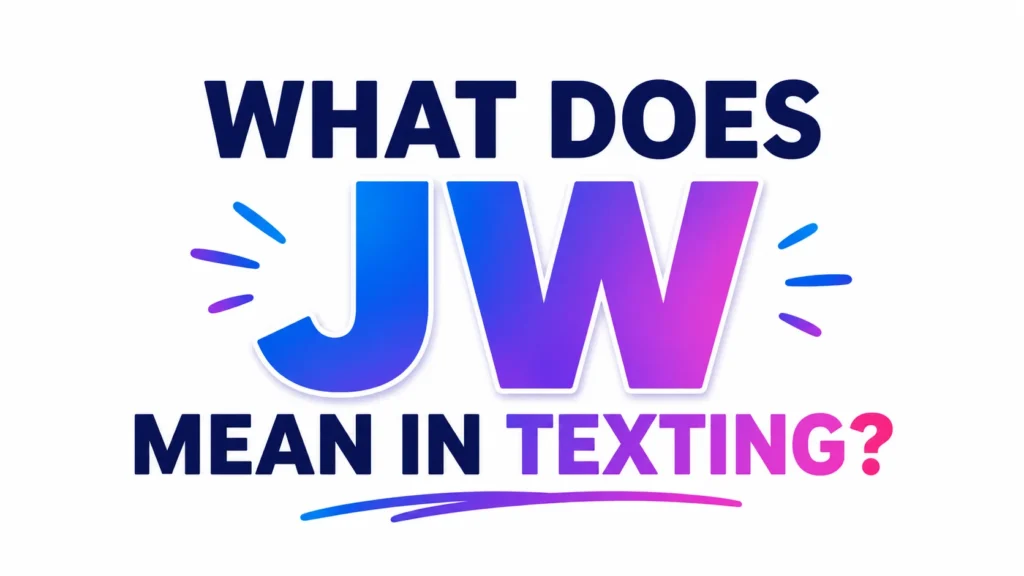
What Does JW Mean in Texting? – Quick Meaning
In texting, JW most commonly stands for:
“Just Wondering”
People use it when asking a question in a casual, non-pushy way. It softens the question and signals curiosity rather than demand.
Quick Definition
- Meaning: Just Wondering
- Tone: Casual, friendly, curious
- Common on: Snapchat, Instagram, WhatsApp, text messages, and online chats
- Purpose: To show that a question is being asked casually
Examples
“JW, are you coming tonight?”
“JW, did you finish the project yet?”
“JW, why did you delete your post?”
In each example, the sender is asking something without sounding overly serious or demanding.
Origin & Background
JW emerged during the rise of SMS texting when people had limited character counts and wanted faster ways to communicate.
As mobile texting became more popular in the early 2000s, abbreviations such as:
- LOL (Laugh Out Loud)
- BRB (Be Right Back)
- IDK (I Don’t Know)
- TBH (To Be Honest)
became part of everyday digital communication.
JW followed the same pattern. Instead of typing “just wondering,” users shortened it to two letters.
Over time, the abbreviation spread beyond text messages and became common across social media platforms. Today, you’ll see it in private chats, comment sections, gaming communities, and group conversations.
Its popularity comes from its simplicity. It allows people to ask questions while reducing the risk of sounding nosy, impatient, or confrontational.
Real-Life Conversations
WhatsApp Conversation
1st Person: Hey, haven’t seen you at the gym lately.
2nd Person: Yeah, I’ve been busy with work.
1st Person: JW, are you switching gyms?
2nd Person: Nope, just taking a short break.
Instagram DM
1st Person: That vacation looked amazing!
2nd Person: It really was.
1st Person: JW, where was that beach?
2nd Person: It was in Greece.
TikTok Comments
1st Person: This recipe actually worked.
2nd Person: JW, did you use regular flour or almond flour?
1st Person: Regular flour.
Text Message
1st Person: You seemed quiet today.
2nd Person: Just tired.
1st Person: JW, everything okay?
2nd Person: Yeah, thanks for asking.
These examples show how JW helps make questions feel more relaxed and considerate.
Emotional & Psychological Meaning
Although JW is only two letters, it carries subtle emotional meaning.
When someone uses JW, they’re often trying to:
- Show curiosity
- Reduce pressure
- Sound friendly
- Avoid appearing demanding
- Keep the conversation comfortable
In many cases, adding “JW” makes a question feel less intrusive.
For example:
Without JW:
“Why didn’t you reply?”
This may sound accusatory.
With JW:
“JW, why didn’t you reply?”
This feels softer and more conversational.
I’ve seen many people use JW when they genuinely want information but don’t want the other person to feel interrogated. It acts almost like a social cushion that protects the tone of the conversation.
This reflects a broader trend in modern communication: people increasingly use language to manage emotions and maintain positive relationships while staying efficient.
Usage in Different Contexts
Social Media
On Snapchat, Instagram, TikTok, and Facebook, JW often appears before a question.
Examples:
- “JW, what filter did you use?”
- “JW, where did you buy that?”
It signals friendly curiosity.
Friends & Relationships
Among friends, JW is extremely common.
Examples:
- “JW, are you free later?”
- “JW, did you talk to Sarah?”
It keeps conversations casual and comfortable.
Work & Professional Settings
JW occasionally appears in workplace messaging apps, but caution is advised.
Example:
- “JW, do we have a deadline for this project?”
While acceptable in informal team chats, writing out “just wondering” is often more professional.
Casual vs Serious Tone
JW works best in casual discussions.
For serious conversations involving sensitive topics, the abbreviation can sometimes feel too informal.
When NOT to Use It
There are situations where JW may not be the best choice.
Formal Business Communication
Avoid using it in:
- Job applications
- Client emails
- Official reports
- Academic correspondence
Sensitive Conversations
Questions involving:
- Health concerns
- Personal loss
- Legal matters
often deserve more direct and respectful wording.
High-Stakes Discussions
If clarity is important, spelling out your full question is usually better than relying on abbreviations.
Cross-Generational Communication
Some people may not recognize JW and could become confused.
Common Misunderstandings
Assuming It Means Something Negative
Some people mistakenly think JW sounds suspicious or passive-aggressive.
In reality, it usually expresses simple curiosity.
Confusing It with Other Abbreviations
JW can sometimes be mistaken for:
- Initials of a person’s name
- Organization abbreviations
- Religious references
Context usually makes the intended meaning clear.
Tone Confusion
Text lacks facial expressions and voice tone.
A harmless “JW” can occasionally be interpreted as:
- Judgment
- Criticism
- Hidden frustration
This depends largely on the relationship between the people involved.
Comparison Table
| Expression | Meaning | Tone | Usage |
|---|---|---|---|
| JW | Just Wondering | Curious | Casual questions |
| FYI | For Your Information | Informative | Sharing information |
| TBH | To Be Honest | Honest | Giving opinions |
| IDK | I Don’t Know | Neutral | Expressing uncertainty |
| IMO | In My Opinion | Personal | Sharing viewpoints |
| BTW | By The Way | Conversational | Changing topics |
| NVM | Never Mind | Dismissive | Ending a topic |
| IDC | I Don’t Care | Opposite attitude | Lack of interest |
Key Insight
JW stands out because it isn’t focused on giving information—it’s focused on asking for information in a polite, low-pressure way. That makes it one of the friendliest abbreviations used in modern texting.
Variations / Types
1. JW?
A quick standalone way to ask something casually.
2. Just wondering…
The full version of JW.
3. JW lol
Adds humor and lightheartedness.
4. JW haha
Makes the question feel playful.
5. JW btw
Combines curiosity with a topic change.
6. JW if…
Used when asking conditional questions.
7. JW because…
Introduces a reason for asking.
8. Seriously JW
Emphasizes genuine curiosity.
9. Random JW
Signals a spontaneous question.
10. JW though
Adds a conversational, reflective tone.
How to Respond When Someone Uses It
Casual Replies
- “Yeah, definitely.”
- “Not really.”
- “Maybe later.”
Funny Replies
- “Nice try, detective.”
- “That’s classified information.”
- “You’ll find out soon enough.”
Mature Replies
- “Good question. Here’s what happened.”
- “I appreciate you asking.”
Respectful Replies
- “Thanks for checking in.”
- “I’m glad you asked.”
- “Everything’s okay, thanks.”
Regional & Cultural Usage
Western Culture
JW is widely recognized among younger and middle-aged internet users. It is commonly used in everyday texting.
Asian Culture
English-language abbreviations are increasingly common, especially among younger social media users, though JW may not be as universally understood.
Middle Eastern Culture
Usage varies depending on language preference. English-speaking users often recognize it, particularly in online communities.
Global Internet Usage
Because social media connects people worldwide, JW has become part of a broader internet vocabulary.
Generational Differences
Gen Z
- Uses abbreviations frequently.
- Quickly understands JW.
Millennials
- Generally familiar with texting shorthand.
- Often use JW naturally.
Older Generations
- May prefer the full phrase “just wondering.”
- Sometimes need clarification.
Is It Safe for Kids?
Yes.
JW simply means “Just Wondering” and is generally considered a harmless texting abbreviation.
Parents should still encourage children to understand online communication context, but JW itself is not offensive, inappropriate, or dangerous.
FAQs
What does JW stand for in texting?
JW most commonly stands for “Just Wondering.”
Is JW rude?
No. It is usually used to make questions sound more polite and casual.
What does JW mean on Snapchat?
On Snapchat, JW almost always means “Just Wondering.”
Can JW be used in professional messages?
It can, but writing out “just wondering” is usually more professional.
Is JW popular among Gen Z?
Yes. Many Gen Z users recognize and use JW regularly.
Does JW have multiple meanings?
It can have other meanings in specific contexts, but in texting, “Just Wondering” is by far the most common.
How do you reply to JW?
Simply answer the question that follows it, just as you would in a normal conversation.
Conclusion
Understanding what does JW mean in texting can make digital conversations much easier to navigate. In most situations, JW simply means “Just Wondering”—a friendly, low-pressure way to ask a question.
Its popularity comes from its ability to soften conversations and express curiosity without sounding demanding. Whether you’re chatting on Snapchat, texting friends, responding to Instagram messages, or participating in online discussions, you’ll likely encounter JW sooner or later.
Once you know its meaning, those two small letters become much less mysterious. More importantly, you’ll be able to use them confidently and understand the tone behind the messages you receive.