If you’ve recently seen someone write “ATP” in a text message, Instagram comment, TikTok caption, or WhatsApp chat, you’re not alone in wondering what it means.
Internet slang changes quickly, and abbreviations often develop meanings that differ from their traditional definitions. As a result, many people encounter ATP online and feel confused because the context doesn’t always make its meaning obvious.
The good news is that ATP is relatively easy to understand once you know how it’s used in modern digital conversations. Whether you’re scrolling through social media, chatting with friends, or reading online comments, understanding ATP can help you better interpret the tone and intent behind a message.
In this guide, you’ll learn the meaning of ATP in text, where it came from, how people use it today, and how to respond naturally when someone sends it to you.
ATP in Text – Quick Meaning
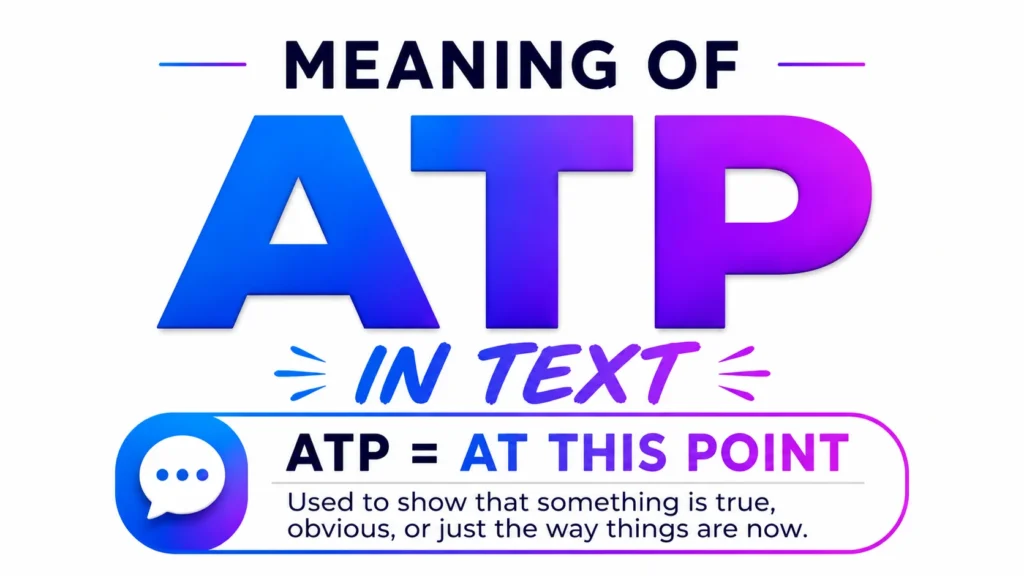
What Does ATP Mean?
In texting and social media conversations, ATP usually means:
“At This Point.”
People use it when discussing a situation that has reached a certain stage, especially when expressing frustration, acceptance, disappointment, amusement, or resignation.
For example:
- “ATP, I’m just going home.”
- “ATP, there’s nothing else we can do.”
- “ATP, I’m laughing because crying won’t help.”
The phrase helps people summarize how they currently feel about a situation.
Quick Definition
ATP = At This Point
Common purposes:
- Expressing frustration
- Showing acceptance
- Giving up on a situation
- Reflecting on current circumstances
- Making humorous observations
Example Quotes
“ATP, I need a vacation.”
“ATP, I’m not even surprised anymore.”
“ATP, just order the pizza.”
Origin & Background
Where Did ATP Come From?
ATP existed long before social media, but it originally referred to different things in science, sports, and business. In online communication, however, ATP evolved into shorthand for “At This Point.”
As texting culture expanded, people looked for faster ways to express common phrases. Typing ATP became quicker than repeatedly writing “at this point.”
Social Media’s Influence
Platforms such as TikTok, Instagram, Snapchat, and X helped popularize the abbreviation.
Short-form content encourages brevity. Consequently, users began shortening everyday phrases into acronyms that fit captions, comments, and quick replies.
Cultural Evolution
The meaning became especially popular among younger internet users who enjoy conversational shorthand.
Over time, ATP moved beyond texting and became a common expression in memes, reaction posts, and viral videos.
How the Meaning Evolved
Initially, ATP appeared mainly in casual text messages.
Today, it often carries emotional context, humor, sarcasm, or exasperation depending on how it’s written.
For example:
- “ATP I’m done.”
- “ATP this is actually funny.”
- “ATP nobody knows what’s happening.”
The abbreviation now communicates both information and emotion.
Real-Life Conversations
WhatsApp Conversation
Person A:
Did they finally fix the internet?
Person B:
Nope.
Person A:
ATP I’m just using mobile data.
Instagram DM
Person A:
You’ve been waiting for that package for two weeks.
Person B:
ATP I don’t think it’s ever arriving.
TikTok Comments
Person A:
This show has so many plot twists.
Person B:
ATP I’m watching just to see how intense it gets.
Text Message Conversation
Person A:
Did your flight get delayed again?
Person B:
Yes.
Person A:
ATP they should give you a free ticket.
Emotional & Psychological Meaning
What Emotion Does ATP Express?
ATP often signals that someone has reached a mental or emotional conclusion.
The emotion can vary depending on context:
- Frustration
- Acceptance
- Exhaustion
- Humor
- Disappointment
- Relief
Why People Use It
People naturally seek shortcuts when expressing complex emotions.
ATP helps summarize an entire emotional journey in just three letters.
Instead of explaining every detail, a person can simply say:
“ATP, I’m moving on.”
Readers instantly understand that events have led to that conclusion.
What It Reveals About Modern Communication
Modern messaging favors speed and emotional efficiency.
Many abbreviations survive because they communicate feelings quickly. ATP works well because it captures a moment of realization.
A Realistic Personal Scenario
Imagine waiting weeks for a job application response.
You check your email every day. Nothing arrives.
Eventually you text a friend:
“ATP, I’m applying somewhere else.”
That simple phrase communicates frustration, acceptance, and a decision all at once.
Usage in Different Contexts
Social Media
On social media, ATP often appears in:
- Captions
- Comments
- Memes
- Reaction posts
Example:
“ATP, we all deserve a three-day weekend.”
Friends & Relationships
Friends use ATP to express thoughts honestly and casually.
Examples:
- “ATP, just tell me the truth.”
- “ATP, let’s stop arguing.”
Work and Professional Settings
ATP is generally uncommon in formal communication.
Professional emails typically avoid internet slang.
Instead of ATP, people usually write:
- At this stage
- Currently
- Given the situation
Casual vs Serious Tone
Casual:
“ATP, let’s grab burgers.”
Serious:
“ATP, we need to discuss our future plans.”
Context determines whether the phrase feels playful or significant.
When NOT to Use It
Formal Business Communication
Avoid ATP in:
- Job applications
- Professional reports
- Client emails
- Academic papers
Not everyone understands internet slang.
Cross-Generational Communication
Older recipients may not recognize ATP.
This can create unnecessary confusion.
Sensitive Conversations
During serious discussions involving health, legal matters, or emotional crises, abbreviations may seem dismissive.
Clear language often works better.
Situations Likely to Cause Misunderstanding
Because ATP has multiple meanings outside texting, some readers may think you’re referring to science, sports, or another subject.
When clarity matters, write the full phrase.
Common Misunderstandings
Confusing ATP with Scientific Terms
Many people first recognize ATP as a biological term.
However, internet conversations usually mean “At This Point.”
Assuming It Always Signals Anger
ATP can express frustration, but not always.
Sometimes it communicates humor or acceptance.
Missing the Emotional Context
The phrase itself isn’t emotional.
The surrounding message determines its tone.
Compare:
- “ATP I’m laughing.”
- “ATP I’m exhausted.”
The same abbreviation supports very different emotions.
Taking It Literally
ATP is often figurative.
People use it to summarize a broader situation rather than identify a precise moment in time.
Comparison Table
| Expression | Meaning | Tone | Usage |
|---|---|---|---|
| ATP | At This Point | Reflective | Current situation |
| TBH | To Be Honest | Honest | Personal opinions |
| IDC | I Don’t Care | Indifferent | Dismissive reactions |
| IMO | In My Opinion | Neutral | Sharing viewpoints |
| SMH | Shaking My Head | Disappointed | Reacting to mistakes |
| FR | For Real | Agreement | Confirmation |
| NVM | Never Mind | Withdrawal | Ending discussion |
| Eventually | Opposite style expression | Neutral | Future outcome |
Key Insight
ATP stands out because it focuses on a person’s current conclusion after experiencing a situation. Unlike many slang terms, it often carries emotional reflection rather than simple agreement or disagreement.
Variations / Types
ATP I’m Done
Meaning: Total frustration.
Used when someone has reached their limit.
ATP I’m Tired
Meaning: Emotional or physical exhaustion.
Shows fatigue with a situation.
ATP Just Leave It
Meaning: Acceptance.
Signals a decision to stop pursuing something.
ATP It’s Funny
Meaning: Amusement.
Used when events become unexpectedly entertaining.
ATP We Move
Meaning: Moving forward.
Popular in social media culture.
ATP I Don’t Care
Meaning: Detachment.
Shows reduced emotional investment.
ATP Let Them
Meaning: Acceptance of others’ choices.
Reflects emotional maturity.
ATP Just Go
Meaning: Encouraging action.
Used when delays become frustrating.
ATP It’s Whatever
Meaning: Indifference.
Signals emotional neutrality.
ATP I’m Over It
Meaning: Closure.
Shows someone has mentally moved on.
How to Respond When Someone Uses It
Casual Replies
- “Fair enough.”
- “I get that.”
- “Honestly, same.”
Funny Replies
- “ATP, we’re all surviving somehow.”
- “ATP, the universe is improvising.”
- “Sounds like a plot twist.”
Mature Replies
- “That makes sense.”
- “You’ve probably thought it through.”
- “I understand your perspective.”
Respectful Replies
- “I respect your decision.”
- “Thanks for sharing how you feel.”
- “That sounds reasonable.”
Regional & Cultural Usage
Western Culture
ATP is widely recognized among younger social media users.
It often appears in casual online conversations.
Asian Culture
Usage varies significantly.
English-speaking online communities understand ATP, while many local-language communities may not use it regularly.
Middle Eastern Culture
The abbreviation appears most frequently among bilingual users who consume global social media content.
Global Internet Usage
TikTok, Instagram, Snapchat, and messaging apps have helped ATP become internationally recognizable.
Generational Differences
Gen Z
Gen Z users frequently employ ATP in memes, texts, and social posts.
Millennials
Millennials may recognize ATP but often use complete phrases more frequently.
Older generations may be unfamiliar with it altogether.
Is It Safe for Kids?
Understanding Context
Yes, ATP is generally safe for children and teenagers.
The abbreviation itself contains no offensive meaning and is commonly used to mean “At This Point.”
Parents should still consider context because any phrase can appear within conversations involving mature topics. The expression itself, however, is harmless.
FAQs
What does ATP stand for in text messages?
ATP usually stands for “At This Point” in texting, social media, and online conversations.
Is ATP a positive or negative expression?
Neither. ATP can express positive, negative, or neutral emotions depending on the situation.
Is ATP used on TikTok?
Yes. ATP frequently appears in TikTok comments, captions, and reaction videos.
Can ATP mean something else?
Yes. Outside texting, ATP may refer to scientific, medical, business, or sports-related terms.
Should I use ATP in professional emails?
Generally no. Writing “At This Point” in full is more professional and easier to understand.
Why is ATP popular online?
It saves time, feels conversational, and efficiently communicates emotional conclusions.
How do I know which ATP meaning applies?
Look at the context. In casual social media conversations, ATP almost always means “At This Point.”
Conclusion
Understanding the meaning of ATP in text messages makes modern online communication much easier to follow. In most cases, ATP simply means “At This Point,” helping people express their thoughts, frustrations, acceptance, or conclusions in a quick and relatable way.
Its popularity reflects how digital communication continues to evolve. People want efficient ways to share emotions, and ATP accomplishes that with just three letters.
The next time you see ATP in a message, comment, or caption, you’ll be able to understand not only the definition but also the emotional context behind it. That deeper understanding can help you communicate more confidently and connect more naturally in today’s fast-moving online world.